 Itnetic Technologies
Game protection
Your Minecraft server stays up. Your players never notice us.
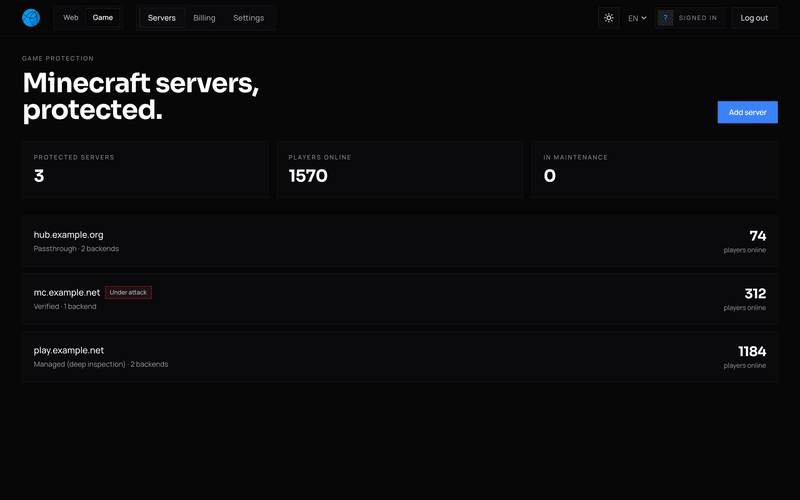
Attacks on game servers arrive as thousands of connections that look exactly like players logging in. We screen every one of them before it reaches you, and let the real players straight through.
How it works
Three steps, and none of them are on your server.
- 01
Point your address at us
Your server stays exactly as it is. Change where your address points and connections arrive at our network instead — no plugin, no mod, no config change.
- 02
Every connection is screened first
Before a connection can cost your server a slot, a world load or a single tick, it passes through us — so an attack never turns into lag for the people actually playing.
- 03
Real players just play
A genuine player connects the way they always have, on an unmodified client, to the same address. The protection is invisible to them.
What it does
Built for how game servers actually get attacked.
A game server is not a website: it holds long-lived connections and spends real work on every join attempt.
Tuned to your server, not to a number in a config file
A fixed threshold is a catastrophe for one server and a quiet evening for another. Ours learns what normal looks like for yours and reacts when your traffic stops resembling itself.
Bots prove themselves. Players prove nothing.
A connection we are unsure about is asked to prove it belongs to a real account — seconds for a human, ruinous at thousands of connections. Genuine players are never asked anything.
A challenge that lives inside the game
When more proof is needed, the challenge is drawn in Minecraft itself. No browser tab and no third-party verification service — which would put someone else’s outage directly on your login path.
Your server keeps its own authentication
Your server stays in online mode and authenticates every player itself. That also closes the hole where a leaked server address lets anybody connect under any username.
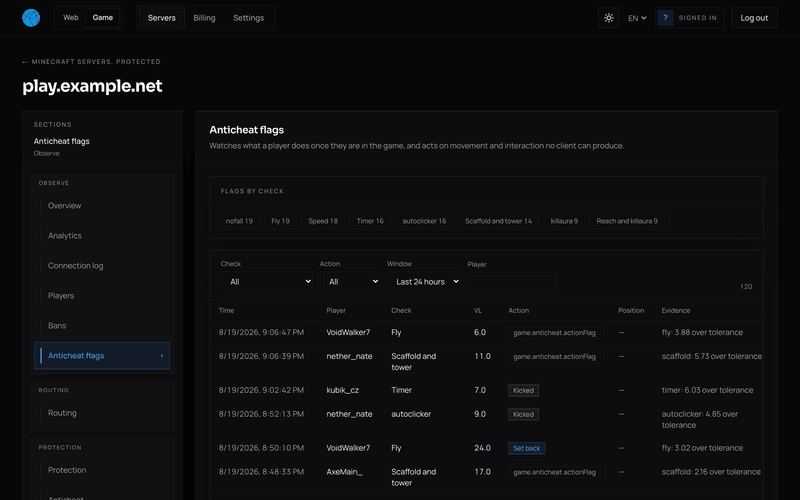
Cheating is caught while it happens, not reported to you after
A player who holds a real account and cleared every check at the door can still fly across the map, hit someone through a wall, or see ore through solid stone. We watch for that too, on the same connection, measured against what the game itself allows rather than against a list of known cheat clients — flying and speed, aimed hits that were not physically possible, and tools that see or dig through the world you built. A first offense is corrected quietly by putting the player back where they actually were; only a sustained pattern ends the session. Nothing to install on your server or a player’s machine.
A queue, not a closed door
At the player limit the next arrivals wait in an ordered line, shown their place and rough wait, instead of getting an error and going elsewhere.
Bans enforced before the door
Ban somebody once and they stop reaching your server at all. They occupy no slot, open no connection to your machine, and get no further opportunity to do whatever got them banned in the first place. Bans that name an account are honoured only where that account has genuinely been verified, so nobody is ever banned because somebody else typed their name.
Your listing stays green under a ping flood
Server-list pings are trivially cheap to send and have always been a free way to hammer a server that is doing nothing wrong. We answer them ourselves from a recent snapshot, so a flood of them costs your server nothing — and your listing keeps showing the right player count and message instead of going dark exactly when people are trying to find you.
Attackers do not get a clean first impression
Attacks on game servers are overwhelmingly rented botnets, and the same addresses move from one server to the next. An address that has already proven hostile against another server on our network arrives at yours carrying that history. It never blocks anyone on its own — the worst a reputation can do is ask somebody to prove they are a real player.
VPN and hosting traffic gets asked, not banned
A large share of genuine players connect through a VPN or a hosting provider’s network, and blocking that category outright quietly throws away members of your community. We raise the bar for them instead: prove you are a player, then go and play.
Every refusal explains itself
A player who is turned away sees a branded screen with a real reason on it — not a silent timeout that makes your server look broken and sends them to ask you why. The words on their screen and the reason in your log are the same words, so support conversations start from the same fact.
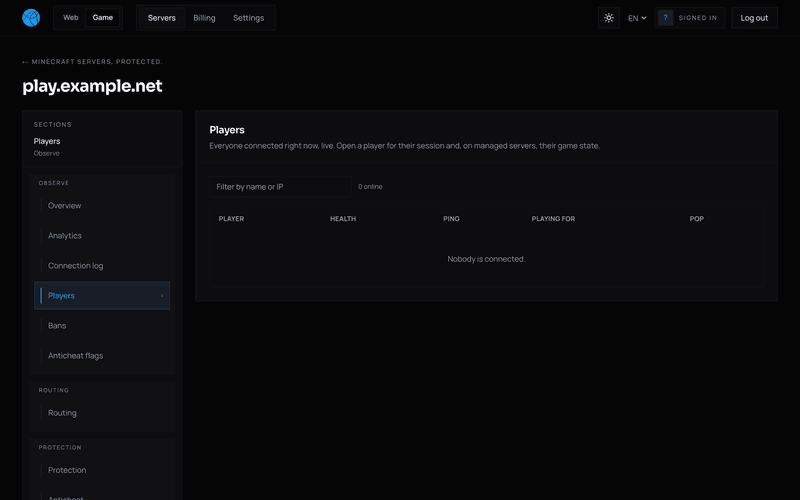
A record of who got in and who did not
Every join attempt is recorded: what arrived, what was allowed through, what was stopped and why it was stopped. When a community member asks whether the server was attacked last night, the answer is something you can point at rather than something you have to remember.
One network, one bill, one dashboard
Game protection runs on the same edge network and the same dashboard as your websites and APIs. There is no second vendor to wire in, no second invoice, and no separate console to learn.
Two experiences
The same protection looks completely different from either side.
What your players get
- The same address they have always used, on an unmodified client.
- No plugin, no mod, no launcher change, no account linking.
- A place in line with their position on it when the server is full, instead of a rejection.
- A clear, branded reason on screen in the rare case they are ever turned away.
- A server listing that keeps answering while an attack is happening.
What an attack runs into
- Screening that happens before your server spends anything on the connection.
- Detection calibrated against your server’s own normal traffic, not a public number.
- A proof-of-player step that costs an automated tool far more than it costs a person.
- A reputation assembled across every server on our network.
- Bans and blocks enforced at our edge, so your machine never sees the attempt.
What we support
Java Edition servers, vanilla and modded. Bedrock Edition is not supported today. The first time a player is asked to verify, clients older than 1.20.5 reconnect once; newer clients are sent back automatically and never notice it happened.
Pricing
Included in every plan
Game protection is not a separate product or a paid add-on. Every plan — including the free one — comes with protected Minecraft servers and a concurrent-player allowance, and the numbers scale with the plan.
FAQ
Questions?
Does it add lag?
Connections are relayed through the point of presence closest to your players, and once somebody is in the game their connection is a straight pipe. The screening work happens while a player is connecting, not while they are playing.
Do my players need to install anything?
No. No mod, no plugin, no launcher change and no account linking. They connect to the same address on an unmodified client.
Do I have to change my server configuration?
No. Your server keeps its own settings and keeps authenticating players itself. The only thing that changes is where your address points.
Does it work with modded servers?
Yes — Java Edition servers are supported whether they are vanilla or modded. Bedrock Edition is not supported today.
What happens when my server is full?
Arriving players are held in an ordered queue and shown their position, rather than being rejected outright. As slots free up the queue advances and they are let in.
Does it also catch players who are already cheating in-game?
Yes. Flying, speed, aimed hits that were not physically possible, and tools that see or dig through the world are watched on the same connection, judged against what the game itself allows rather than a list of known cheat clients. A first offense is corrected quietly; only a sustained pattern ends the session. This runs alongside the connection protection at no extra cost, for supported servers.
Will real players get blocked?
The design goal is that they are not. Anything we are unsure about is asked to prove it is a player rather than being refused, which costs a genuine person a few seconds at most. Connections from VPNs and hosting networks are challenged rather than blocked precisely because so many real players use them.
Does this hide my server’s address?
Players connect to us rather than to your machine, so your server’s own address is not what your community passes around. Anything already published stays published, so it is still worth changing if it has been leaked.
Is game protection billed separately?
No. It is included in every plan, free tier included. Plans differ in how many servers you can protect and how many players can be connected at once.
Go deeper
Guides to Minecraft server protection
- Minecraft server DDoS protection →
- Minecraft bot attacks and join floods →
- What is a Minecraft anticheat? →
- Fly, speed and timer hacks →
- Killaura and reach hacks →
- X-ray, nuker and scaffold detection →
- Minecraft CAPTCHA and player verification →
- How to protect your Minecraft server IP →
- Ping floods and server queues →
- What is a DDoS attack? →
- How to stop a DDoS attack →
Stop losing evenings to it.
Point your server address at us and let the attacks arrive somewhere that is built to absorb them.