 Itnetic Technologies
Web CDN
A CDN that serves your sites from the edge nearest each visitor.
Caching and delivery run on the same edge network that filters your attacks. Less latency, fewer round trips, and protection baked in — not bolted on.
Edge caching
Static assets are served from the point of presence nearest each visitor, cutting latency and load on your origin.
Protection built in
Delivery runs on the same network that mitigates your attacks. One layer, not two vendors to wire together.
Less origin load
Cached responses never touch your servers, so traffic spikes and attacks do not turn into origin bills.
Compression at the edge
Text, fonts and SVG go out compressed with gzip, Brotli or zstd, whichever the visitor’s browser supports.
Purge in about 30 seconds
Clear one path prefix or the whole cache from the dashboard or the API. A purge takes effect within about 30 seconds.
Live in minutes
The same two DNS records that enable protection enable delivery. Nothing else to configure.
FAQ
Questions?
Is the CDN separate from DDoS protection?
No. Delivery and mitigation run on one edge network, so protection is always on for cached traffic.
What does the CDN cache?
By default, static content: CSS, JavaScript, images, fonts, JSON and plain text, for as long as your origin’s Cache-Control allows or for a TTL you set. You can also ignore query strings or cache every response. Even when caching everything, responses that set cookies or need authorization are skipped.
Is Itnetic a Cloudflare CDN alternative?
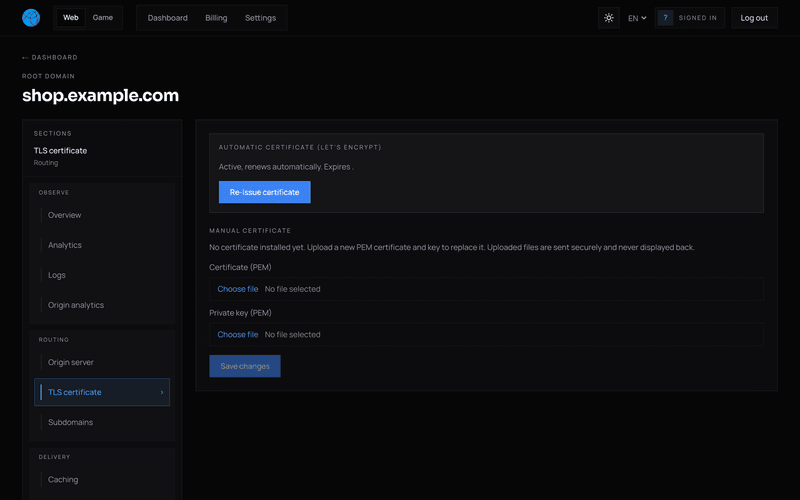
For caching and delivering websites, yes. Edge caching, compression, cache purge, automatic TLS certificates and origin load balancing are on every plan, the free one included, together with the DDoS protection and WAF. Itnetic does not offer edge compute or object storage, so if you build on Workers or R2, Cloudflare remains the better fit.
Does the CDN cost extra?
No. The CDN is part of every plan, including the free Starter plan. Plans differ by the number of domains and the bandwidth delivered, and attack traffic is never counted against it.
Where are your edge nodes?
Frankfurt and Prague (Europe), Toronto (North America) and Singapore (Asia Pacific), with more on the way. See the network page for the live list.
How do I enable it?
Point your domain at Itnetic with two DNS records. Caching and delivery are active immediately.